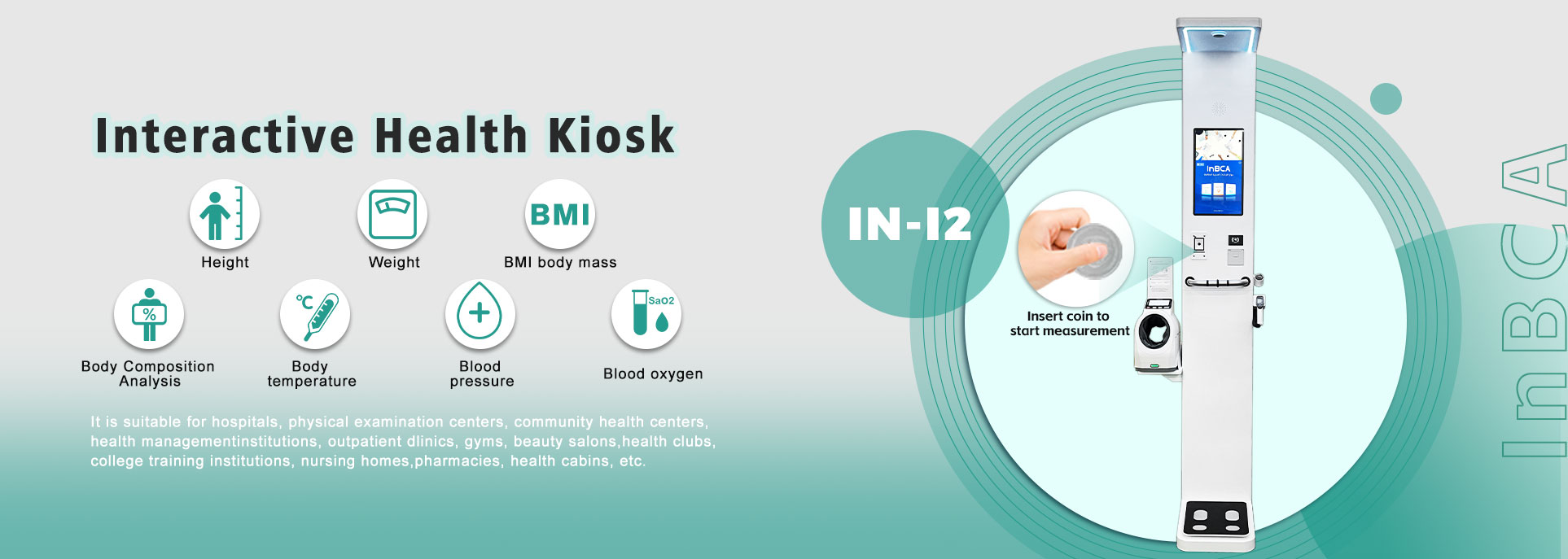
With the rapid advancement of digital healthcare and artificial intelligence, the Interactive Health Kiosk has emerged as an essential smart device in community healthcare, corporate wellness, pharmacies, and public spaces. It combines traditional medical testing functions with modern interactive interfaces, offering users a convenient, efficient, and low-barrier approach to health management.
What is an Interactive Health Kiosk?
An Interactive Health Kiosk is an intelligent terminal that integrates multiple physiological parameter measurement devices, a touchscreen operating system, health questionnaires, and remote consultation features. Users can independently measure basic health indicators such as blood pressure, heart rate, body temperature, blood oxygen saturation, weight, and body fat in an unattended environment. Some advanced models also support ECG, blood glucose, and uric acid testing.
Key Features
-
Multi-parameter Self-testing
Supports rapid measurement of common health indicators such as blood pressure, heart rate, blood oxygen, temperature, weight, BMI, and blood glucose. Data can be automatically uploaded to the cloud or printed as a report. -
Identification & Personal Health Records
Users can log in via ID card, healthcare card, facial recognition, or QR code to create a personal health profile, enabling historical data tracking and trend analysis. -
AI-based Health Assessment & Recommendations
Based on measurement results and user-provided information (e.g., medical history, lifestyle), the system generates preliminary health assessment reports and offers lifestyle suggestions regarding diet, exercise, etc. -
Telehealth Connectivity
Supports video or text-based consultations with doctors or health coaches, completing a full service loop of “testing – assessment – intervention”. -
Multilingual & Accessible Design
Equipped with voice guidance, multilingual interfaces, and a simple user flow, making it suitable for the elderly, foreigners, and users with varying literacy levels.
Application Scenarios
-
Community Health Centers – Improves primary care testing capacity and reduces staff workload.
-
Corporate Campuses & Office Buildings – Provides daily health monitoring for employees, supporting corporate wellness programs.
-
Pharmacies & Checkup Centers – Adds value as a complementary service, attracting foot traffic and increasing customer loyalty.
-
Airports, Stations & Shopping Malls – Enables public health monitoring and health education.
-
Senior Care Facilities & Wellness Communities – Facilitates chronic disease monitoring for the elderly.