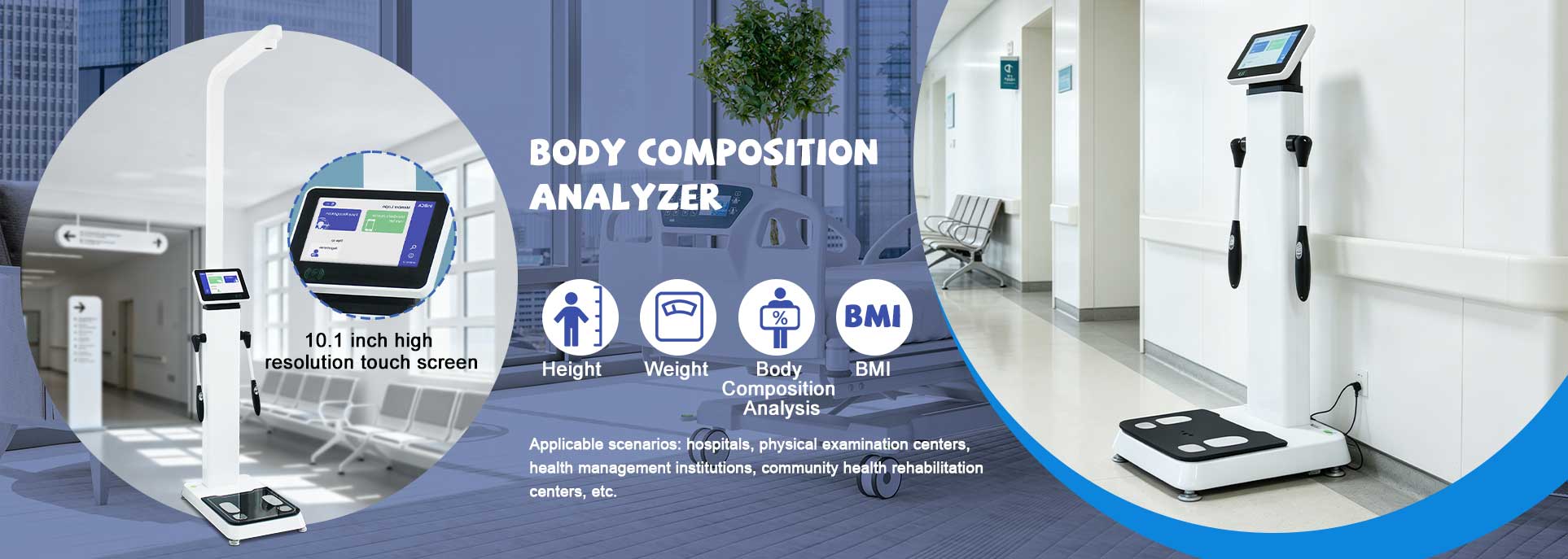
Whether found in hospital physical examination departments, community health service centers, or specialized health management institutions, a device integrating height, weight, body composition analysis, and BMI measurement capabilities is emerging as a "smart assistant" dedicated to safeguarding public health: the Body Composition Analyzer. Using technology as its pen and data as its ruler, it sketches a clear and comprehensive health profile for every user.
This Body Composition Analyzer begins by breaking the stereotypes associated with traditional diagnostic equipment through its user-centric design. Equipped with a 10.1-inch high-resolution touchscreen, it features a clear, intuitive interface and a simple, easy-to-follow operation workflow; consequently, both professional medical staff and general users can easily master the device and complete their examinations with ease. Requiring no complex setup—users simply follow the on-screen prompts to step onto the platform and grasp the handles—the device allows for the rapid initiation of a comprehensive health assessment, thereby significantly enhancing both diagnostic efficiency and user experience.
In terms of core functionality, the device achieves a "one-stop" solution for the multi-dimensional collection of health data. It seamlessly integrates four key functions: precise measurement of height and weight, in-depth analysis of body composition, and calculation of the Body Mass Index (BMI). This eliminates the cumbersome process of the past, which required the use of multiple devices and repeated tests to obtain a complete set of health metrics.
Height and weight measurements are captured using high-precision sensor technology, ensuring minimal data error and providing a reliable foundation for subsequent health assessments.
The body composition analysis function accurately identifies the proportions of key bodily components—such as fat, muscle, and water—helping users visualize their body fat percentage, muscle mass, and other vital indicators. This capability serves to dispel the common misconception that "normal weight automatically equates to good health."
Furthermore, the real-time calculation of the BMI allows for a quick determination of whether a user's weight falls within a healthy range, providing a scientific reference point for effective weight management.
These comprehensive diagnostic data points are no longer merely cold, impersonal numbers; rather, they serve as the "code" for interpreting one's physical condition. Physicians can utilize this data to formulate more targeted health guidance plans for their patients; health management specialists can leverage the analysis results to craft personalized diet and exercise regimens for their clients; and individuals can track their data over time to clearly observe changes in their health status, enabling them to make timely lifestyle adjustments and practice preventive care.